
 Apple
Apple
 Samsung
 Google Pixel


 Samsung

Does the Galaxy S26 Ultra Need a Waterproof Case? Everyday Protection Explained
The Samsung Galaxy S26 Ultra already has serious protection built into the phone. Samsung rates the device IP68 for dust and water resistance, so an extra waterproof case is not essential for every owner or every accidental splash. But that does not mean the phone is protected from everything daily life can throw at it.
The important distinction is between factory water resistance and complete everyday protection.
A quality Galaxy S26 Ultra waterproof case can add another sealed physical barrier while also helping protect the screen, camera lenses, corners and edges from drops, scratches, sand, dirt and worksite debris. That extra protection becomes particularly relevant if your phone regularly travels through wet commutes, construction sites, beaches, campsites, airports or unpredictable Australian weather.
So, does your S26 Ultra actually need one? It depends less on the phone's IP rating and more on where and how you use it.
Is the Samsung Galaxy S26 Ultra Already Water-Resistant?
Yes. The Galaxy S26 Ultra is IP68-rated for water and dust resistance. Samsung Australia states that the phone is rated under laboratory conditions for submersion in up to 1.5 metres of fresh water for up to 30 minutes. However, Samsung also states that its water and dust resistance is not permanent and can diminish with normal wear and tear.
That distinction matters.
The "IP" in IP68 refers to ingress protection. The first number relates to protection from solid particles such as dust, while the second relates to liquid ingress. An IP68 rating therefore tells you a great deal about how well the handset itself is sealed against dust and controlled fresh-water exposure.
What it does not mean is that the phone is indestructible or suitable for unrestricted use around every type of water.
Samsung specifically says the S26 Ultra is not advised for beach or pool use and recommends ensuring the charging port is dry before charging. Its broader Australian care guidance also warns against exposure to forcefully moving water.
Samsung further explains that impacts can damage the water- and dust-resistant characteristics of an IP68 device. That is particularly relevant when discussing phone cases: the question is not simply whether a brand-new phone can withstand fresh water in controlled laboratory conditions. It is how you want to protect a valuable handset through months or years of drops, wear, travel and everyday accidents.
IP68 also does not protect a bare display from being scratched by grit, stop a camera lens striking concrete or cushion the phone when it slips from your hand.
That is where a protective case serves a different purpose.
Why Everyday Water, Dust and Drop Exposure Still Matters
The accidents worth thinking about are rarely dramatic.
Most people are not deliberately dropping their Galaxy S26 Ultra into deep water. More realistic problems are a coffee knocked over beside the phone, sudden rain during a commute, wet hands after washing up, dust around a worksite or a phone slipping onto concrete while getting out of a ute.
Often, two risks happen at the same time.
You might be walking through heavy rain when the wet phone slips from your hand. Sand from a beach bag can reach the phone before the device is dropped onto a hard surface. Fine workshop dust may gather around exposed openings before the phone is tossed into a toolbox. A camera corner can take the first impact when the phone falls from a desk.
That combination is why looking only at the Galaxy S26 Ultra IP68 rating can miss the bigger picture.
Samsung's own current Australian guidance notes that if a Galaxy device is exposed to water or other liquids, internal damage or corrosion may still occur even if the device initially appears to operate normally.
A rugged case does not change Samsung's specifications. Instead, it creates another physical layer between the phone and the environment.
For someone who spends most of the week at a clean office desk, that additional sealing may be more protection than they need. For someone moving between construction sites, rain, camping trips, beaches and busy public transport, the calculation can be very different.
Full-Body Protection vs a Standard Bumper Case
A standard bumper or open-face rugged case usually concentrates on impact protection around the back, sides and corners. A full-body waterproof case goes further by enclosing the phone and combining impact protection with screen coverage, camera protection, sealed edges and protection around vulnerable openings. Neither is automatically better for everyone; they are designed for different levels of exposure.
A good bumper case is often an excellent everyday choice.
It can improve grip, protect the back from scratches, absorb some corner impacts and use raised edges to reduce direct contact between a surface and the display or camera lenses.
It can also be slimmer and easier to remove than a sealed full-body case.
For many careful users, that is enough.
The main difference is that an ordinary open-front design still leaves much of the handset itself exposed to the environment. Your screen remains directly exposed unless you install a separate protector. Camera lenses may rely primarily on a raised rim. Openings remain accessible to dirt and fine particles, and the case does not form a waterproof enclosure around the phone.
A properly designed full-body case approaches protection differently.
The front and rear sections work together as an enclosure. The display can sit behind an integrated screen protector, camera lenses can receive dedicated coverage, reinforced corners can deal with impacts and sealed edges can create a barrier against water and dust.
It is therefore better to think of the choice as targeted protection versus integrated protection.
If your priority is keeping the phone slim in a low-risk environment, a quality bumper may make perfect sense. If your phone repeatedly encounters rain, sand, debris, dirty hands or hard working environments, a sealed full-body design may be more appropriate.
Think of Screen, Camera and Edge Protection as One System
Modern flagship phones are made from increasingly sophisticated materials, and Samsung says the Galaxy S26 Ultra uses Gorilla Armour 2 on the front, Gorilla Glass Victus 2 on the rear and an Armour Aluminum frame. Those features improve the handset's inherent durability, but they do not eliminate the possibility of damage from an unlucky impact.
A phone also does not conveniently choose how it lands.
It may hit a corner, clip the edge of a step, slide face-down across a rough surface or make first contact through the camera area.
That is why complete protection makes more sense when viewed as a system.
Reinforced edges help manage impact around the perimeter. Screen coverage places another physical layer between the display and scratches or direct surface contact. Camera protection deals with another exposed and important section of the handset. A sealed outer shell helps keep water, dust, sand and debris away from areas you would otherwise need to clean separately.
There is also a convenience argument.
Without a full-body case, someone seeking extensive coverage might use a bumper case plus a separate tempered-glass protector plus individual camera protectors. That approach can work well, but it involves multiple components.
A full-body design integrates those protective elements into one enclosure.
The goal is not simply to make a phone "more waterproof". It is to minimise the number of common everyday hazards reaching the handset in the first place.
What Does a Waterproof Full-Body Case Add?
An IP68 full-body case adds a separate sealed enclosure around the Galaxy S26 Ultra. Depending on the individual case design, that enclosure can combine water and dust resistance with impact protection, built-in screen coverage, camera protection and protected edges. This is broader physical protection than relying on the handset's IP68 ingress rating alone.
The Coral Case approach is a useful example.
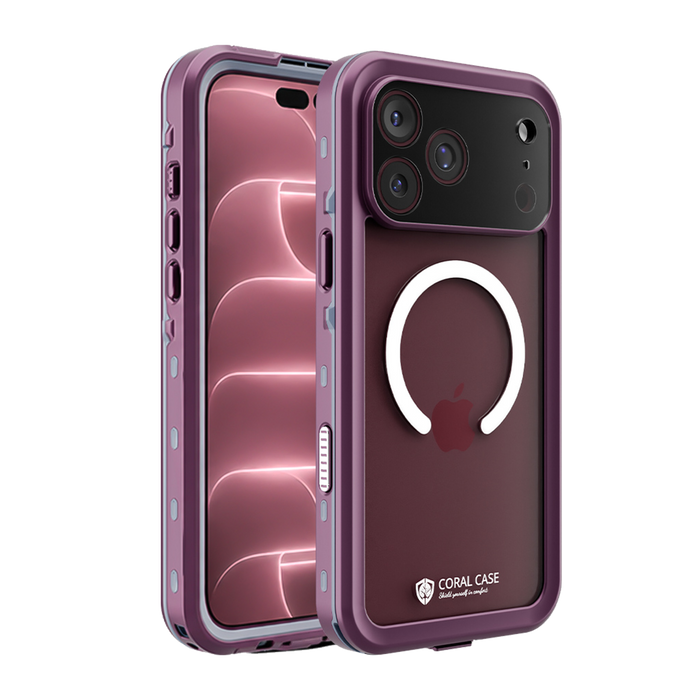
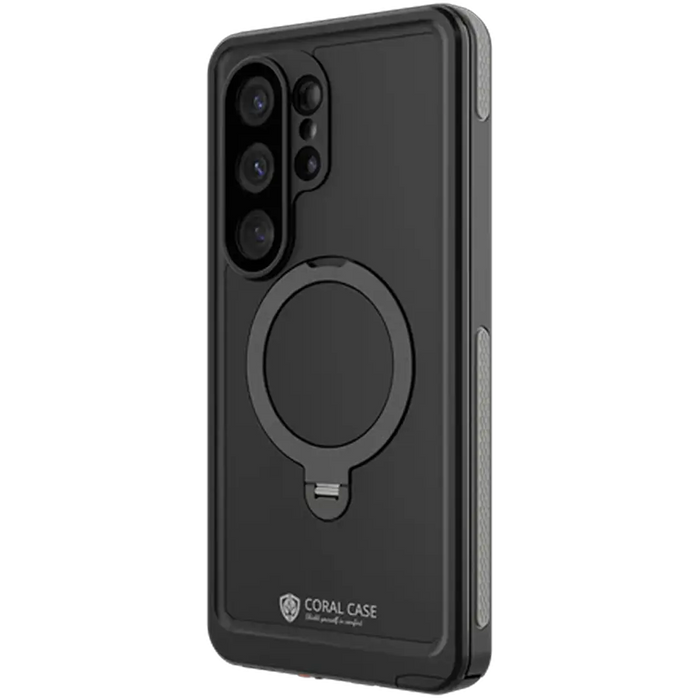
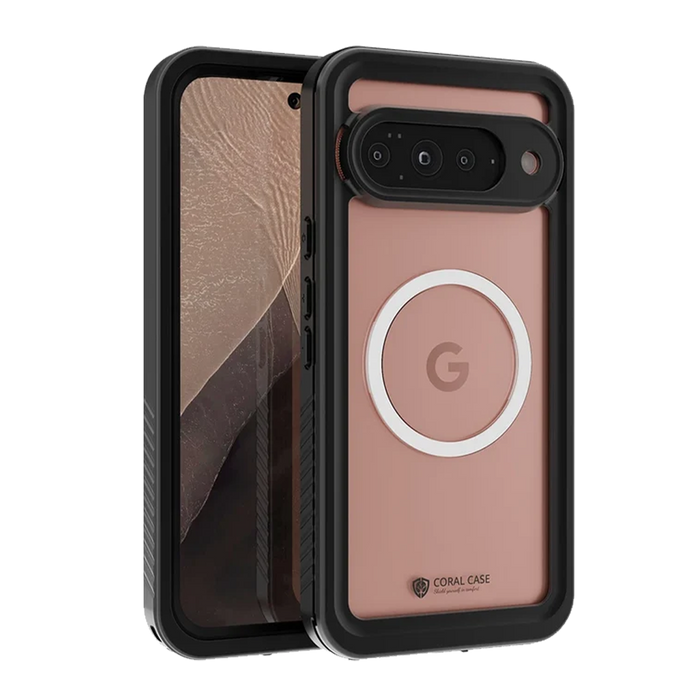
The Galaxy S26 Ultra waterproof case is an Orange and Clear full-body design made specifically for the Galaxy S26 Ultra.
According to Coral Case's current product specifications, the case itself carries an IP68 rating and is rated for submersion to 6.6 feet — approximately two metres — for up to 60 minutes. This specification belongs to the case, and should not be confused with Samsung's separate IP68 specification for the handset itself.
Coral Case also describes the enclosure as protecting against dust, dirt, sand and fine debris. Its construction includes reinforced shock-absorbing corners and advertised drop protection of up to 12 feet. These are separate impact-protection claims rather than benefits derived simply from the IP68 rating.
The front incorporates a built-in HD screen protector, while an integrated camera-glass protector is designed to cover the lenses. Coral Case also lists fingerprint scanner functionality and S Pen access, important considerations on a protective case that encloses more of the handset than a traditional bumper.
This illustrates the real argument for a full-body waterproof case.
You are not simply buying another IP rating to place over an existing IP-rated phone. You are adding an external layer that combines environmental sealing with physical protection around parts of the handset that its factory water resistance was never intended to cushion from impacts.
MagSafe Convenience Without Giving Up Rugged Protection
Yes, magnetic accessories can be used with compatible Galaxy S26 Ultra cases that incorporate an appropriate magnetic ring. The Coral Case full-body S26 Ultra case has a built-in magnetic ring and is listed as MagSafe compatible, allowing supported magnetic wireless charging and accessories without removing the rugged case.
This matters more in daily use than it might appear on a specification sheet.
A protective case is only practical if you can leave it installed without constantly working around it.
At your desk, that might mean placing the phone onto a compatible magnetic wireless charger. In the car, it could mean attaching the handset to a compatible magnetic mount rather than fitting and removing a clamp every time you drive. Other compatible magnetic accessories can similarly connect to the integrated ring.
For commuters and travellers in particular, magnetic mounting can make a heavier-duty case much easier to live with.
MagSafe compatibility should not, however, be confused with protection. The magnetic ring is a convenience feature. The sealed enclosure, reinforced corners, screen protection and camera coverage provide the protective functions.
It is the combination that makes the design useful as an everyday rugged case.
Who Actually Benefits Most From a Waterproof Galaxy S26 Ultra Case?
Different lifestyles expose a phone to very different risks. For some owners, a full waterproof case may be unnecessary. For others, it can address hazards they encounter every week.
Commuters
Daily commuting creates more opportunities for phone damage than it first appears.
You might be checking directions while walking through rain, grabbing your phone with wet hands, balancing it with a coffee while waiting for a train or pulling it from your pocket on a crowded platform.
A commuter does not need a waterproof case because they expect to go swimming with their S26 Ultra.
The practical value comes from protecting against combinations such as rain and a pavement drop, spilled drinks at cafés, dirty public


